
Europe is becoming an increasingly important market for alternative cat litter materials, and paper cat litter is benefiting from that shift. The reason is not simply that consumers want “greener” products. The stronger explanation is that European cat owners are making purchase decisions at the intersection of sustainability, pet well-being, household convenience, and trust in product claims. Public market data does not usually isolate paper litter as a standalone segment, but it consistently shows rising demand for sustainable, low-dust, odor-controlling, and alternative-material litter products across Europe. That is the clearest evidence base for why paper litter is gaining attention.
The first structural driver is simple: Europe has a very large and mature cat-owning population. FEDIAF’s latest published statistics show that Europe has 299 million pets across 139 million households, and cats account for a major share of the region’s pet economy. In a related FEDIAF release, cats are described as the most popular pet in Europe, with around 127 million cats in 26% of households. A market of that size creates room for premiumization and material innovation, especially in everyday-use categories like litter.
The second driver is broader category growth. Grand View Research estimates that the European cat litter products market was worth USD 5.48 billion in 2023 and projects a 5.1% CAGR from 2024 to 2030. The same source notes that the market is being shaped by pet humanization, demand for cleanliness, and investment in alternative litter materials such as paper, corn, walnut shells, and wood. That matters because it shows paper litter is not a niche story in isolation; it is part of a wider transition away from purely traditional mineral-based options toward materials that better match changing consumer values.
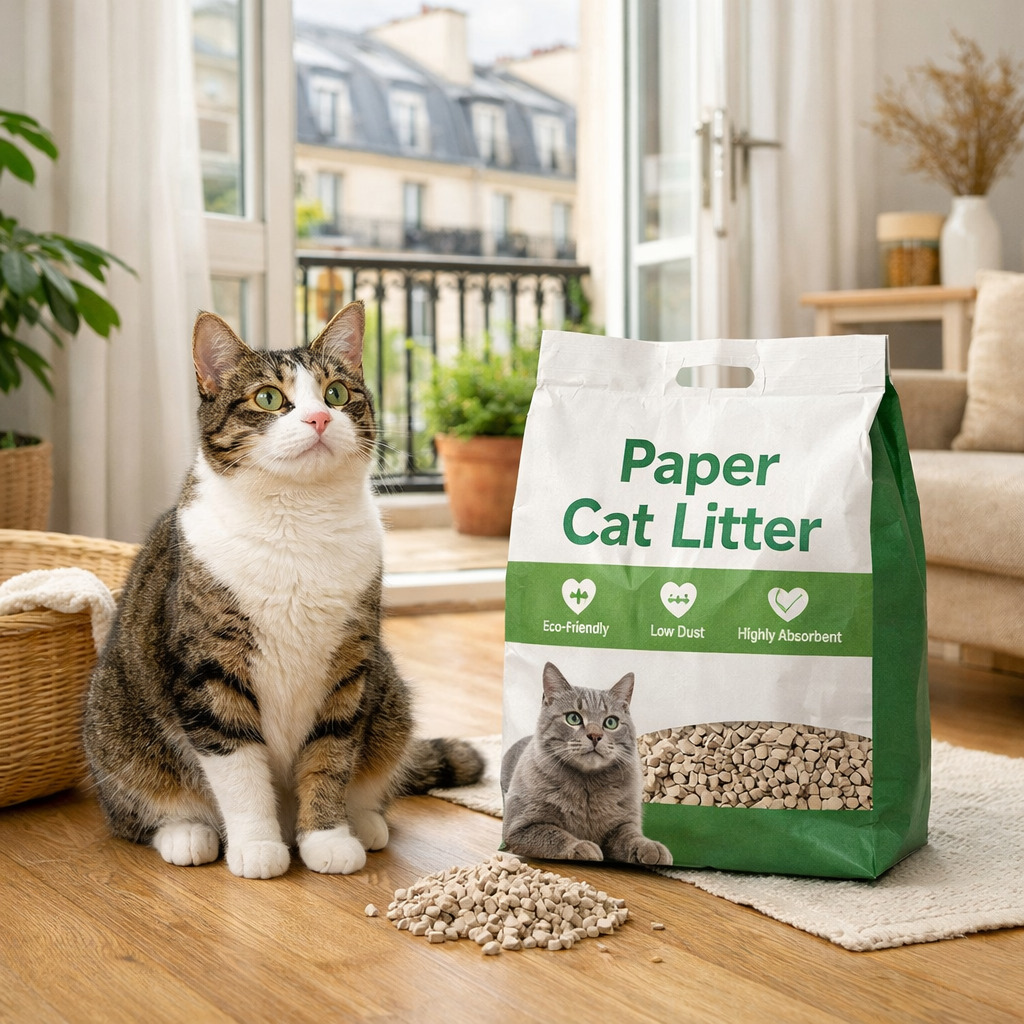
Another important reason is sustainability. European consumers are unusually attentive to the environmental profile of the products they buy. A European Commission Eurobarometer survey found that 73% of EU citizens say a product’s environmental impact is an important factor in purchasing decisions, and 60% say they have bought products specifically because of their lower environmental impact. Another recent Eurobarometer result found that Europeans strongly support circular-economy thinking and expect companies to take responsibility for pollution and waste. For paper cat litter, this is highly relevant: the category is typically associated with recycled fiber, lower reliance on mined raw materials, and a clearer circularity story than conventional clay-based litter.
(Picture insert 1.png)
However, sustainability alone does not explain purchase behavior. European consumers still expect performance. Public market sources repeatedly show that odor control, cleanliness, and ease of use remain central purchase criteria. Grand View Research notes that consumers in Europe are looking for stronger absorbency, effective odor management, and convenient cleanup. A UK market summary from MarkNtel Advisors similarly highlights consumer preference for eco-friendly, low-dust, odor-controlling, and hypoallergenic cat litter products. This is exactly where paper litter has gained relevance. It is often chosen not because it wins every metric against every competing substrate, but because it performs well in several high-priority areas at once: low dust, lighter carrying weight, soft texture, and acceptable day-to-day odor management for many households.
Low dust is especially important. In category guidance for cat owners, veterinary and pet-care sources frequently describe recycled paper litter as a lower-dust option that can be gentler for cats and households with sensitivities. VCA Animal Hospitals notes that natural litters such as recycled paper can be eco-friendly and low in dust, while PetMD specifically points out that paper-based litter is sometimes recommended around surgery recovery, subject to veterinary advice. These are not market-share statistics, but they help explain why paper litter resonates with buyers who are worried about respiratory sensitivity, post-surgery care, or simply a cleaner home environment.
Convenience also matters more than many suppliers assume. Cat litter is heavy, repetitive, and not emotionally exciting to buy. That is why weight and handling can influence switching behavior. Paper litter is typically perceived as easier to carry and easier to store than dense mineral litter, which fits well with urban households, apartment living, and older consumers. This becomes even more relevant as e-commerce grows. In Europe, supermarkets and hypermarkets still accounted for about 40% of cat litter sales in 2023, but online sales are projected to grow at 6.2% annually through 2030, faster than the overall market. In online channels, bulky, heavy products create friction. A lighter-format litter is easier to ship, easier to deliver, and often easier for consumers to reorder.
There is also a trust and packaging dimension. McKinsey’s 2025 research on European consumers and sustainable packaging found that the market broadly values both sustainability and affordability, not one without the other. This aligns closely with the paper litter proposition. European consumers are not automatically impressed by generic green messaging; they are more likely to respond when environmental positioning is tied to something tangible, such as recycled content, reduced dust, lighter handling, or a more credible packaging story. In other words, paper litter works better in Europe when it is presented not just as “eco-friendly,” but as a practical product with measurable user benefits.
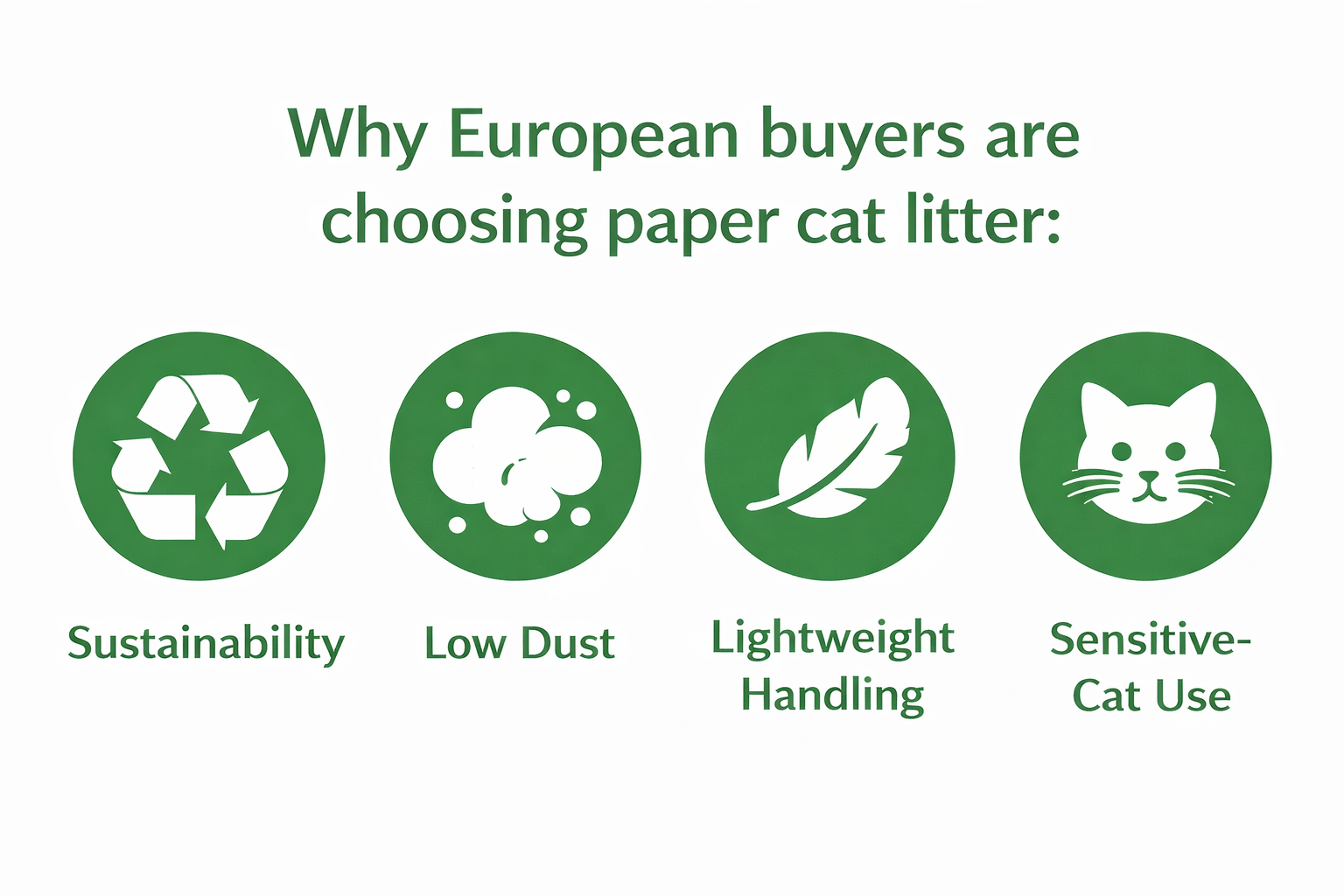
That said, the shift has limits. Europe is not abandoning traditional litter overnight. Grand View Research reports that clay still held 81.5% of the European market by raw material in 2023, and clumping litter accounted for 70.3% by product type. This means paper litter is still competing against deeply established habits, especially where consumers prioritize hard clumping and maximum odor locking. So the market opportunity is real, but it is selective. Paper litter is most attractive where buyers value low dust, material sustainability, lightweight use, or special-use situations more than they value the strongest possible clump.
In practical terms, European consumers are turning to paper cat litter because it fits a broader shift in how pet products are evaluated. The category sits at the meeting point of environmental awareness, health sensitivity, convenience, and modern retail behavior. The strongest public evidence does not show that Europe has already become a paper-litter market; it shows that Europe is steadily becoming a more favorable market for non-traditional litter materials, and paper litter matches several of the region’s fastest-growing purchase drivers. That is why its relevance is increasing.
Note on evidence scope: public market reports usually group paper litter inside broader alternative-material or natural-litter categories rather than publishing a standalone Europe paper-litter market size. The conclusion above is therefore based on directly reported Europe cat litter market data plus directly reported consumer preference data, and then applied cautiously to paper litter as one of the beneficiary materials in that broader shift.
